Loading case study...
FinTech & Lending
AI-Powered Loan Prioritization
An intelligent prioritization engine that helps underwriting teams surface the right applications earlier — using historical patterns, borrower attributes, and configurable business rules while keeping every final lending decision with the underwriter.
IndustryFinTech & Lending
ServiceAI & Automation, Product Engineering
ClientLending Platform Client
Timeline12 Weeks
Team size3 Engineers
40%
Faster first-pass review
3x
More applications reviewed per day
5
Automated approvals without underwriter sign-off
12 weeks
From kickoff to production
The challenge
A first-in-first-out queue was treating every loan the same
The client’s underwriting team was working through loan applications largely in the order they arrived, regardless of risk profile, complexity, or urgency.
Straightforward applications and cases requiring deeper scrutiny entered the same queue. This meant underwriters were spending similar initial effort across very different cases, while applications requiring earlier attention could remain buried behind routine submissions.
The underwriting team already knew which borrower attributes, application characteristics, and historical patterns typically indicated a straightforward case versus one requiring closer review.
The problem was that much of this knowledge lived with individual underwriters rather than in the system responsible for routing the work.
What we built
A risk-scoring engine that prioritizes, not replaces, underwriter judgment
We built an AI-assisted prioritization layer that evaluates incoming applications using historical application data, borrower attributes, configurable business rules, and operational signals. Each application receives a prioritization score that helps determine when it should be reviewed, rather than whether the loan should be approved. This allows urgent or higher-complexity applications to surface earlier while straightforward cases move through a more efficient review queue. Most importantly, the system remains decision-support software: every final lending decision stays with the underwriter.
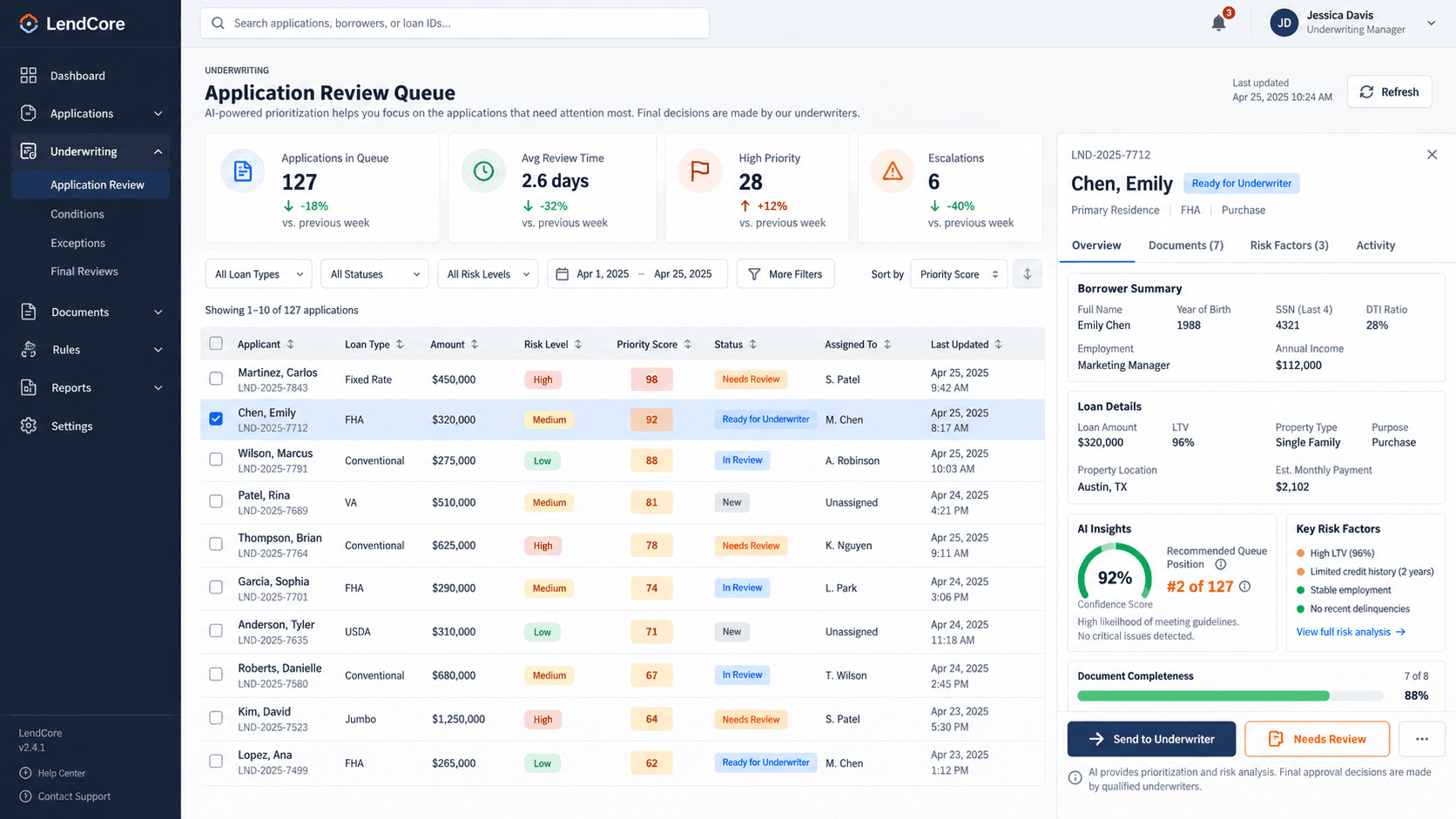
Risk scoring model
Uses historical application patterns and relevant borrower attributes to calculate a relative prioritization score.
Prioritized review queue
Automatically reorders applications according to risk, complexity, urgency, and configurable business criteria.
Technologies used
PythonReactNodePostgreSQLAWSREST API
The results
Faster reviews, with underwriters still making every call
The new prioritization workflow helped the underwriting team focus attention according to application characteristics rather than simple arrival order.
- First-pass review became more efficient for straightforward applications.
- Applications requiring greater scrutiny could surface earlier in the review queue.
- Underwriters gained a clearer indication of which cases deserved immediate attention.
- Every final lending decision continued to require underwriter sign-off.
- Prioritization scores and routing decisions remained available for audit and compliance review.
- Business rules could be adjusted as lending policies and operational priorities evolved.
Have a similar workflow to fix?
If manual review or a first-in-first-out process is slowing your team down, we'd be glad to talk through whether a similar approach could work for you.